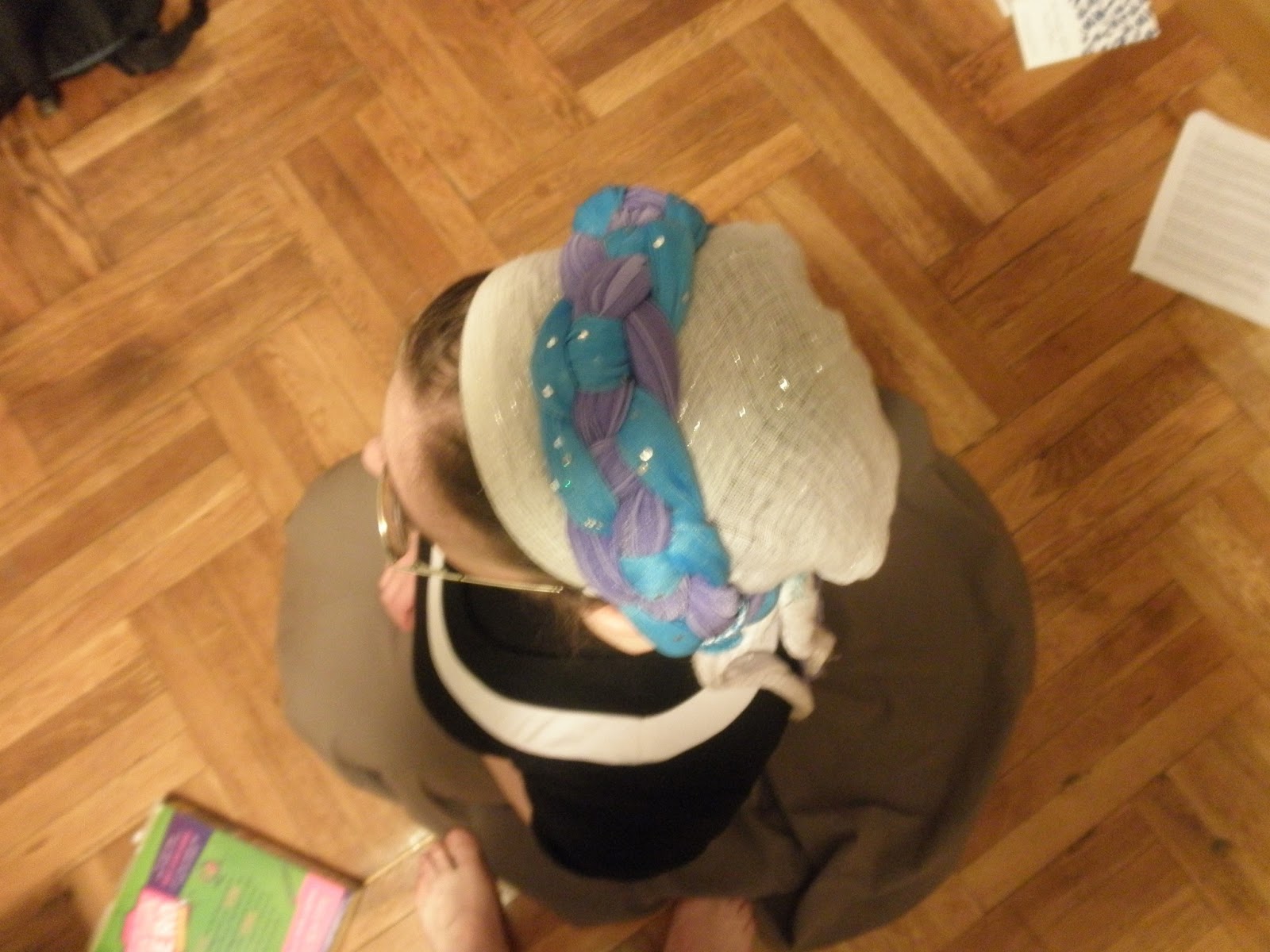
I wrapped the first scarf, and tied it in the back, with two equal ends. I used a smaller scarf for the second one, so I tied it quite unevenly- with one long end, and one so-short-it-almost-didn't-exist end. I took the 3 hanging tails (2 from the first scarf, and 1 from the second), and wrapped a ribbon around one of the ends, and braided it. I secured the braid, and tied the excess ribbon into a bow. The accessory was just a random throw-on, it felt right, and I wanted to bring the colors together with my mostly-black outfit, as well.
A look at Jewish head-covering from a not-quite-Orthodox perspective. Style, halakha, home-made coverings, and personal reflections, all included.
Monday, May 27, 2013
Photos Need A Title
Here's a covering I put together a few weeks ago. My plans were to put together something that felt comfortable, secure, and inspiring. I ended up with this wrap, using 2 rectangular scarves, one ribbon, and a hair clip.
I wrapped the first scarf, and tied it in the back, with two equal ends. I used a smaller scarf for the second one, so I tied it quite unevenly- with one long end, and one so-short-it-almost-didn't-exist end. I took the 3 hanging tails (2 from the first scarf, and 1 from the second), and wrapped a ribbon around one of the ends, and braided it. I secured the braid, and tied the excess ribbon into a bow. The accessory was just a random throw-on, it felt right, and I wanted to bring the colors together with my mostly-black outfit, as well.
Wednesday, May 22, 2013
How's That for A Hat (or Veil)?
The article this links to isn't much- but take a look at the bride's covering(s). How's that for a hat? Or a veil? Or a hat+veil? Take a look particularly at the 5th and, most clearly, 7th photographs.
Monday, May 20, 2013
Medieval-esque
Remember my first attempt with wrapping a scarf-braid around my head? I promised to let you know what happened with a braid with more different strands. Here's the result, with a five-stranded braid, using 5 different scarves (some quite thin, as I didn't want to turn into the braid-head monster):
The braid is made using the tutorial here, which is very easy to understand and to carry off.

I secured the first end with a hair clip, while I braided, then brought the ends together at the back of my head and used a hair elastic, covered with a scrunchie, to secure the ends. The tails have a lot of bulk, rather reminiscent of a decorative head-band I saw on a little girl at shul recently- it had lots of ribbons hanging down in the back.

My impression was that it looked sort of like we imagine the Medieval period (rather than like what it was actually like, which I'm less sure of).
It's fun, and it's something you can make in advance, then take off, and slip back on later. Good perhaps for packing to transform yourself from work clothes to something more festive.
The braid is made using the tutorial here, which is very easy to understand and to carry off.
I secured the first end with a hair clip, while I braided, then brought the ends together at the back of my head and used a hair elastic, covered with a scrunchie, to secure the ends. The tails have a lot of bulk, rather reminiscent of a decorative head-band I saw on a little girl at shul recently- it had lots of ribbons hanging down in the back.
My impression was that it looked sort of like we imagine the Medieval period (rather than like what it was actually like, which I'm less sure of).
It's fun, and it's something you can make in advance, then take off, and slip back on later. Good perhaps for packing to transform yourself from work clothes to something more festive.
Thursday, May 9, 2013
Shabbos Tails
This was a recent Shabbos style- two scarves, one headband. The fun is that all the "work" is done with one scarf, with one tail wrapped over the head. The other scarf just weaves in and out of that band, ties behind the ear. It makes a nice accent on the head, and some bulk below for those of us who sometimes miss having hair hanging down.
It makes a lot of effect in front, without a lot of layers to have to worry about. And it adds some height without being overwhelming.
I tend not to like tails hanging down for work days, they tend to say romantic rather than professional to me. For shabbos or a party, I adore them, and this style definitely provides.
This is a side view, so you see how the thing came together structurally.
And apparently, neither Haggai nor I noticed that I had a tag sticking up... Oh well. You see my flaws as well as my creativity.
It makes a lot of effect in front, without a lot of layers to have to worry about. And it adds some height without being overwhelming.
I tend not to like tails hanging down for work days, they tend to say romantic rather than professional to me. For shabbos or a party, I adore them, and this style definitely provides.
This is a side view, so you see how the thing came together structurally.
And apparently, neither Haggai nor I noticed that I had a tag sticking up... Oh well. You see my flaws as well as my creativity.
Tuesday, May 7, 2013
Spiritual Functioning of the Kippah
I was talking to my husband about how he felt about wearing a kippah. What we came up with was this:
Wearing a kippah is about a baseline. It isn't so noticeable in itself, but it means that taking it off is a signal to yourself. Taking it off, or disguising it, means that what you're doing is likely to be questionable.
Sometimes, questioning it may yield the answer that you're answering to another Jewish value that makes doing something that is halakhically marginal appropriate (for example, going into a non-kosher restaurant to be with your family).

Sometimes, it turns out to be a reminder that actually, this isn't a good choice.
But either way, without the baseline, you don't have the reminder. It makes an awareness of other people's gaze into a reminder of God's gaze.
Wearing a kippah is about a baseline. It isn't so noticeable in itself, but it means that taking it off is a signal to yourself. Taking it off, or disguising it, means that what you're doing is likely to be questionable.
Sometimes, questioning it may yield the answer that you're answering to another Jewish value that makes doing something that is halakhically marginal appropriate (for example, going into a non-kosher restaurant to be with your family).
Sometimes, it turns out to be a reminder that actually, this isn't a good choice.
But either way, without the baseline, you don't have the reminder. It makes an awareness of other people's gaze into a reminder of God's gaze.
What message does your kippah (or devotional head-covering practice) send you?
How do you feel about it?
Friday, May 3, 2013
Using Braids
As a kid, I wore my hair in braids pretty much all the time. Really- one braid or two, usually french-braided, was my go-to for years. I'd brush my hair, then go sit down in front of my mother's bed, and she'd braid my hair while she listened to NPR and I read.
I have a long history with braids, in other words. And I love them, they're beautiful. I enjoy playing with different braids for challah, and braiding the dangly edging of my scarves when I'm bored.
I also love playing with braids on my coverings. In the past, I've braided the ends of my scarves, or taken those braided ends and wrapped it around a bun.
This time, I made a braid first, then tied it on around my head.
This one was four-stranded, made of two scarves folded in half and looped together, and sort of improvised. You could just as easily group two ends together, and make a regular three-stranded braid.
I'm going to play with some larger flat braids, and see what they look like (stay tuned). So far, this looks like a nice way of dressing up a plain scarf, using some of those scarves that are too thin to use for a covering on their own. Add it to the list of ways to use a narrow scarf (or two).
I have a long history with braids, in other words. And I love them, they're beautiful. I enjoy playing with different braids for challah, and braiding the dangly edging of my scarves when I'm bored.
I also love playing with braids on my coverings. In the past, I've braided the ends of my scarves, or taken those braided ends and wrapped it around a bun.
This time, I made a braid first, then tied it on around my head.
This one was four-stranded, made of two scarves folded in half and looped together, and sort of improvised. You could just as easily group two ends together, and make a regular three-stranded braid.
I'm going to play with some larger flat braids, and see what they look like (stay tuned). So far, this looks like a nice way of dressing up a plain scarf, using some of those scarves that are too thin to use for a covering on their own. Add it to the list of ways to use a narrow scarf (or two).
Monday, April 29, 2013
Seeing Yourself
A friend recently said that she saw my usual outside head-covered as my geeky presentation, and me with my hair down as a freer and looser self. I'm certainly a geek- but...
My own image of myself is rather the opposite- my covering makes me feel adult and competent and a very different sort of pretty from how I presented myself with my hair down, which tends to feel rather innocent or young when I'm imagining myself.
Covering my hair often does give me that "I'm wearing a crown" feeling that motivational speakers and writers talk about. I feel more dignified and adult, while also feeling beautiful. I think I associate it with stories and historical pieces where only young women wear their hair down- married women, or really, adult women, put their hair up in various setting-appropriate hair-dos.
In other words, covering for me is not only a religious choice, but also a powerful aid to my self-image. I feel more confident, more beautiful, more capable. It surprises me to hear that some people have the opposite reaction to my covering. But I'm sticking to my guns- I'm not letting this disturb my vision of myself, I like it too much.
My own image of myself is rather the opposite- my covering makes me feel adult and competent and a very different sort of pretty from how I presented myself with my hair down, which tends to feel rather innocent or young when I'm imagining myself.
Covering my hair often does give me that "I'm wearing a crown" feeling that motivational speakers and writers talk about. I feel more dignified and adult, while also feeling beautiful. I think I associate it with stories and historical pieces where only young women wear their hair down- married women, or really, adult women, put their hair up in various setting-appropriate hair-dos.
(What I happen to be wearing today)
Only my hair is quite slippery, and while it's very long, it lacks body. And I've never had the interest in figuring out the mysteries of hair spray. So up-dos have never been my thing, I never figured them out. Not to mention that they are generally quite incompatible with a scarf or kippah. In other words, covering for me is not only a religious choice, but also a powerful aid to my self-image. I feel more confident, more beautiful, more capable. It surprises me to hear that some people have the opposite reaction to my covering. But I'm sticking to my guns- I'm not letting this disturb my vision of myself, I like it too much.
How do you envision yourself with your favorite style of covering?
Friday, April 26, 2013
Flattering Your Face
I've posted links to blogs that have talked about choosing hats that flatter your face, in the past. Those have all been aimed a. at hats, b. at situations where you have hair coming out as well, and c. at a general audience.
I'd like to think about similar considerations for scarves. What face shapes are best suited by building up height or by high or low buns? Do layers of scarves draw attention in one direction or another that might interact with emphasizing different parts of your face? What about creating dangling tails or a more tailored look, bringing the eye up? How do all these things interact? What impact do accessories have?
The problem is, I don't really understand this business of face shape, in its complexities. So it's hard for me to think about what sorts of things flatter what face shapes. So I'm hoping to start experimenting on my friends (and any other volunteers), to start forming some ideas.
In the meantime, any thoughts you, my dear readers, might have would be very welcome. What styles suit your face, and what don't? Do you sometimes choose a "less flattering" style because you just like it, or because it sends the right social message, or because it's comfortable, or for some other reason?
I'd like to think about similar considerations for scarves. What face shapes are best suited by building up height or by high or low buns? Do layers of scarves draw attention in one direction or another that might interact with emphasizing different parts of your face? What about creating dangling tails or a more tailored look, bringing the eye up? How do all these things interact? What impact do accessories have?
The problem is, I don't really understand this business of face shape, in its complexities. So it's hard for me to think about what sorts of things flatter what face shapes. So I'm hoping to start experimenting on my friends (and any other volunteers), to start forming some ideas.
In the meantime, any thoughts you, my dear readers, might have would be very welcome. What styles suit your face, and what don't? Do you sometimes choose a "less flattering" style because you just like it, or because it sends the right social message, or because it's comfortable, or for some other reason?
Tuesday, April 23, 2013
Back to Photos
Here's number one: An under-over woven band around my head, with the tails hanging at the sides. I liked it, and the scarf didn't slip, either...
(The picture above somehow reminds me of countless pictures of me from my childhood, although I like it rather more than I liked those, at the time.)
And here's a regular style- base scarf and a band around it, but with a dollar-store cloth flower added around the back. I hadn't realized how big this one was until I put it on, but I guess a little goes a long way, flower-wise. If it were smaller, I might have put it closer to my face. Since it was a dollar though, I can afford the occasional experiment, and have this for days when I feel like drama and excitement.
Sunday, April 21, 2013
Head Covering as a Spiritual Practice: My Story
When I started wearing a kippah, it was a spiritual practice. It made me more aware of my tefillah, it made me more aware of God's presence. First, I wore a covering only when making brachot, studying, or eating. The extra action made me more aware of each moment, of each blessing, of the presence of God.
Then I started covering all the time, and it brought a little bit of that awareness to getting dressed in the morning. Whether I was wearing a kippah or a headband or a scarf, I was aware of having something on my head, and that would help me to remember why I did it. It brought me more awareness of God, for a while.
It also brought me a lot of obnoxious questions and comments. I've blogged about that in the past. "You know that's not for keeping the rain off" about a kippah, and "when did you get married?" when I had a beret on outside, etc. But the spiritual benefits outweighed the social annoyance, and the obligation to do education at any and all times, including while shopping for new bras.
However, over time, my awareness dimmed. A kippah, or a scarf, or whatever I wore, just became something that I put on in the morning, just like a shirt, or socks.
And then I got married. And I had a different awareness of what was on my head. For a little while I was deeply aware of the double meaning of my new way of covering my head. It was a thrill, because it reminded me that I was married (and of how wonderful my husband is, etc- I'm pretty sure that I was a quite typical newlywed). It was also a reminder of the spiritual significance of covering my head, which I'd become sort of numb to.
Now, when I'm aware of anything, it's usually a social marker, what sort of Jew I look like. And that's not nothing. It is a part of my spiritual identity. (Spirituality being generally defined as my connection to something greater than myself, to my community, to meaning, and to myself) But it doesn't help me remember God when I'm seeing a beautiful day outside, or when I'm spending time with the family of a dying patient in the hospital, or when I'm studying Talmud with my husband. And that's an aspect of spirituality that I want to get from my head-covering practice.
So sometimes I think about that- and more often, I don't. And I don't like that numbness. That's Not The Point of this practice, or at least, not the only point. I like that I look frum, I'm not going to lie about it. But that's not the aspect of this that is foundational for me.
So I'm thinking about how to help myself remember.
Is covering spiritual for you? In what way? What keeps it fresh and meaningful?
Then I started covering all the time, and it brought a little bit of that awareness to getting dressed in the morning. Whether I was wearing a kippah or a headband or a scarf, I was aware of having something on my head, and that would help me to remember why I did it. It brought me more awareness of God, for a while.
It also brought me a lot of obnoxious questions and comments. I've blogged about that in the past. "You know that's not for keeping the rain off" about a kippah, and "when did you get married?" when I had a beret on outside, etc. But the spiritual benefits outweighed the social annoyance, and the obligation to do education at any and all times, including while shopping for new bras.
However, over time, my awareness dimmed. A kippah, or a scarf, or whatever I wore, just became something that I put on in the morning, just like a shirt, or socks.
And then I got married. And I had a different awareness of what was on my head. For a little while I was deeply aware of the double meaning of my new way of covering my head. It was a thrill, because it reminded me that I was married (and of how wonderful my husband is, etc- I'm pretty sure that I was a quite typical newlywed). It was also a reminder of the spiritual significance of covering my head, which I'd become sort of numb to.
Now, when I'm aware of anything, it's usually a social marker, what sort of Jew I look like. And that's not nothing. It is a part of my spiritual identity. (Spirituality being generally defined as my connection to something greater than myself, to my community, to meaning, and to myself) But it doesn't help me remember God when I'm seeing a beautiful day outside, or when I'm spending time with the family of a dying patient in the hospital, or when I'm studying Talmud with my husband. And that's an aspect of spirituality that I want to get from my head-covering practice.
So sometimes I think about that- and more often, I don't. And I don't like that numbness. That's Not The Point of this practice, or at least, not the only point. I like that I look frum, I'm not going to lie about it. But that's not the aspect of this that is foundational for me.
So I'm thinking about how to help myself remember.
Is covering spiritual for you? In what way? What keeps it fresh and meaningful?
Subscribe to:
Posts (Atom)