A couple of friends have been lovely to me and sent me links to interesting articles and blogs pertinent to our topic of choice. Here's my thoughts about one of them, with grateful appreciation.
Apparently, NPR has been looking into the price of things around the world- and has come to the price of various headcoverings in Jerusalem. It's a short read, with lots of pictures, many of them well-done. The result: with the exception of items that are both very expensive and implied to be religiously extreme (wigs, black hats, and shtraimels/the equivalent, which get called a "crown" at one point in the piece)(not that I quite disagree on some of those items, but still- I can think something, and still feel odd when someone outside says the same thing), you can buy a cheap version of anything mentioned for $5-10.
Interestingly, wigs are mentioned in a more significant manner than tichels/mitpachot/scarves ("For religious and Orthodox Jewish women, dictates of modesty can mean a wig after marriage. The more natural-looking, the more expensive. Otherwise, all kinds of hats, caps and scarves are available, at all kinds of prices.") but there's a picture of the latter, not the former. In fact, the objects that get the wordage- said wigs and shtraimels, don't get the pictures. It sends a funny mixed message.
Also interesting is that Jewish and Muslim headcoverings are mentioned together- but Jewish ones are called Jewish, and Muslim ones are referred to as Palestinian. In fact, neither the word Islam nor Muslim are mentioned in the article. I'm not sure what to make of the mismatch, but it does seem interesting. Do any of you have thoughts that might illuminate this oddity?
A look at Jewish head-covering from a not-quite-Orthodox perspective. Style, halakha, home-made coverings, and personal reflections, all included.
Tuesday, December 31, 2013
Monday, December 30, 2013
Side Braid, Back After An Absence
It's been a while- I almost forgot about this style. This is a turban with a side-braid over it. I doubled up a thin sash with a narrow scarf in making the side-braid, which gave a little bit more color, and some bulk to the tails that fall over my shoulder.
My favorite aspect of this style is that it has the ability to be done in advance, then assembled, as it were, on the spot, if you want. Great for days when you need to flow from one sort of activity and level of formality into another.
Tutorial coming soon, since I think this one is easier to learn by seeing than by reading a description.
My favorite aspect of this style is that it has the ability to be done in advance, then assembled, as it were, on the spot, if you want. Great for days when you need to flow from one sort of activity and level of formality into another.
Tutorial coming soon, since I think this one is easier to learn by seeing than by reading a description.
Sunday, December 29, 2013
Simple But Matchy
I got this yellow sweater with my mom and sister over Thanksgiving. Thing is, I have almost nothing yellow in my scarf stash. However, I do have this one silk scarf that's white, yellow and orange, a gift from a friend. It all came together fairly easily. One rectangular scarf in what one might call a half-up half-down- one tail over the top of the head, one around the bun, then the yellow and white one twisted and around over the top.
It all went with a purple top under the sweater, so the result was pretty matchy-matchy, but hopefully not over-the-top. Anyway, wearing gifts and things that I associate with people I love always makes me feel good.
Thursday, December 26, 2013
Historical Head Covering: Mehdor
Since some of us have a little more time this week- I seem to be upping the blogging schedule. Here's some pretty interesting information about the Mehdor, a Jewish women's head covering from Morocco.
The Mehdor was made out of silver wire and horsehair or cattlehair. It was basically a combination of a wig and an ornament/hat combination. The mehdor was the most elaborate of Moroccan women’s headdresses, but it was worn daily in one region of the country. It would cover a woman's head from ear-to-ear in front, with two forelocks of "woven hair" visible. Basically, it came with it's own bit of "wig" in the front. These bands would then be gathered into braids (after/behind the visible part) which tied the mehdor onto the woman's head.
(In this image, you can see that the "hair" in front is part of the mehdor.)
On festive occasions, women would add a red silk scarf- called a feshtul- trailing down the back behind the mehdor. Affluent women would then add pearl tiara- called a tasfift- over it. (This tasfift is related to styles worn by Spanish Jews, and shows a connection and impact between the two Jewish cultures.) Over it all a they might add another scarf, called a sebniyya- which would fully conceal the mehdor itself.
(This is an image of a woman wearing a tasfift.)
Creating a mehdor was a collaborative process. First, a silversmith would arrange cattle-tail hair lengthwise, and bind bundles of it with silver wire. He would then attach vertical silver tubular half-cylinders to this base, which were also decorated with enamel cloisonné and inlaid with colorful beads. After that, seamstresses added a padded, layered cotton lining with a cylindrical thickened edge at top. (This gave it shaping.)
Like a number of other historical head coverings (like the Shterntikhl in Eastern Europe, for example) it was used to display family’s wealth.
The Mehdor was made out of silver wire and horsehair or cattlehair. It was basically a combination of a wig and an ornament/hat combination. The mehdor was the most elaborate of Moroccan women’s headdresses, but it was worn daily in one region of the country. It would cover a woman's head from ear-to-ear in front, with two forelocks of "woven hair" visible. Basically, it came with it's own bit of "wig" in the front. These bands would then be gathered into braids (after/behind the visible part) which tied the mehdor onto the woman's head.
(In this image, you can see that the "hair" in front is part of the mehdor.)
On festive occasions, women would add a red silk scarf- called a feshtul- trailing down the back behind the mehdor. Affluent women would then add pearl tiara- called a tasfift- over it. (This tasfift is related to styles worn by Spanish Jews, and shows a connection and impact between the two Jewish cultures.) Over it all a they might add another scarf, called a sebniyya- which would fully conceal the mehdor itself.
(This is an image of a woman wearing a tasfift.)
Creating a mehdor was a collaborative process. First, a silversmith would arrange cattle-tail hair lengthwise, and bind bundles of it with silver wire. He would then attach vertical silver tubular half-cylinders to this base, which were also decorated with enamel cloisonné and inlaid with colorful beads. After that, seamstresses added a padded, layered cotton lining with a cylindrical thickened edge at top. (This gave it shaping.)
Like a number of other historical head coverings (like the Shterntikhl in Eastern Europe, for example) it was used to display family’s wealth.
Wednesday, December 25, 2013
Where Google Can't Provide
I've been working on some more historical headcovering posts- and I'm finding that this is one area where Google image searches, or Google searches of pretty much any sort, are not coming up with anything. I think I've finally found an area too arcane for Google and the internet of 2013-almost-2014.
Pinterest has been a bit better, oddly. I've found some great images there, by searching for the name of a photographer who took many photos of Jewish women in northern Africa in the 1930s, but there are several topics that I've done some writing about, and can't find any images. (There were some excellent ones in the books I was using at the JTS library.)
It's oddly frustrating- here's this area that I'm interested in, and the internet actually can't provide for me. (This is highly reminiscent of my luck with research projects as a kid. My first research project in 4th grade was about the kibbutz, and the only sources I found between school and synagogue library were 1. a film strip, 2. a children's book for little kids, and 3. an adult book about the organization and governance of kibbutzim that was rather above my head. Nevertheless, I wrote a 10 page paper- Lord only knows how.)
It's also strange to think that I'm googling images of a women's head covering that was still worn not much more than a century ago, and come up with lots of pictures of some sort of stuffed cabbage. (Really. Truly.)
With those enticing thoughts, I leave you.
Pinterest has been a bit better, oddly. I've found some great images there, by searching for the name of a photographer who took many photos of Jewish women in northern Africa in the 1930s, but there are several topics that I've done some writing about, and can't find any images. (There were some excellent ones in the books I was using at the JTS library.)
It's oddly frustrating- here's this area that I'm interested in, and the internet actually can't provide for me. (This is highly reminiscent of my luck with research projects as a kid. My first research project in 4th grade was about the kibbutz, and the only sources I found between school and synagogue library were 1. a film strip, 2. a children's book for little kids, and 3. an adult book about the organization and governance of kibbutzim that was rather above my head. Nevertheless, I wrote a 10 page paper- Lord only knows how.)
It's also strange to think that I'm googling images of a women's head covering that was still worn not much more than a century ago, and come up with lots of pictures of some sort of stuffed cabbage. (Really. Truly.)
With those enticing thoughts, I leave you.
Tuesday, December 24, 2013
RIbbon and Braid
It's been a while since I've done a braid. This one is done with a pashmina, a square scarf, and a small ribbon. But before you go for it yourself...
I really liked how this looked, with the second layer of the white-and-grey pashmina pulled over and going straight into the braid, but it didn't stand up well to the needs of the weather. I put the braid up into a hat that I put on to keep my ears warm- it was a chilly day. When I took it down, the ribbon and general arrangement was quite messed up, and I had to take it down to re-do it. So this one seems better for a day when you don't need a hat, or maybe you should just wear ear-muffs instead... (I've never worn ear muffs. Huh.)
Monday, December 23, 2013
A Lovely Event
I had a great time at my first head covering event on Saturday night. A lovely group of women got together, and we ate, and talked, and learned a little, had a small scarf-swap, and then got on to playing with scarves. I talked through some of the source texts that I've shared here, and spoke for just a couple of minutes about some of the observations that I've made about those sources. And in our play, I got to show folks how to do several really pleasant styles, helped people use scarves that they were finding difficult to style, and we did some brainstorming together about using some bulky or otherwise tricky items.
The brainstorming was really special for me, because I wasn't just a guest expert- the community got empowered to play and experiment and create some lovely coverings together. I loved to artistry that came out as we got going.
A very special aspect of the program, which I hadn't planned, was that one of the women who came is involved with a charity that provides head coverings (hats, scarves, perhaps even wigs) to women who are living with cancer. So several hats and several scarves that didn't go in our swap will have new homes making life just a tad easier for people who could use them.
I wish I had photos, but someone else took pictures, so I'll have to wait and hope that I can get some from her... Instead, here's a recent photo of me with a hanging shabbos braid:
And in the end, we wrapped up (sorry for the pun) by putting a scarf on the shul's rabbi when he came to bring my husband and me to the bus station. I think he found a Purim costume for this year (but not as a woman, I promise.)
Of course, I forgot to mention this blog to them, but hopefully I'll eventually make the connection.
Thursday, December 19, 2013
What's New With HowToCover
I'm very excited to be quoted over at The White Hindu, in a post thinking about passing and visibility as a person in a minority religion. Ambaa's thoughts are a fascinating addition to the conversation that Liz and I have both talked about here.
Also, I've been doing some tichel style sessions with friends, in preparation for running a program out in West Hartford, CT on Saturday night. Good stuff has been happening. I've been having fun, my trial students have been enthusiastic, and it's quite exciting to see how things look on another person's face.
Sunday, December 15, 2013
Working Backwards
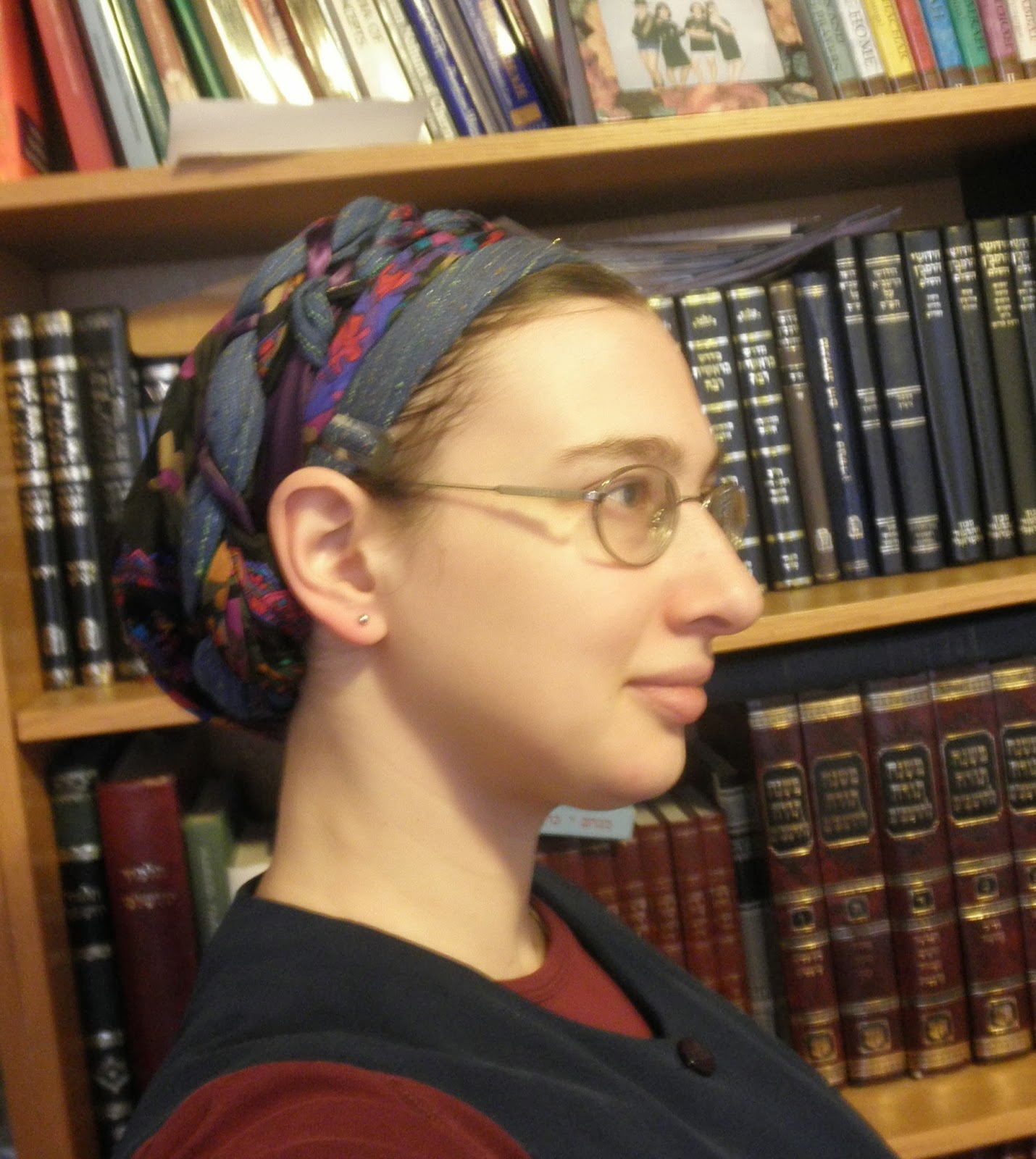
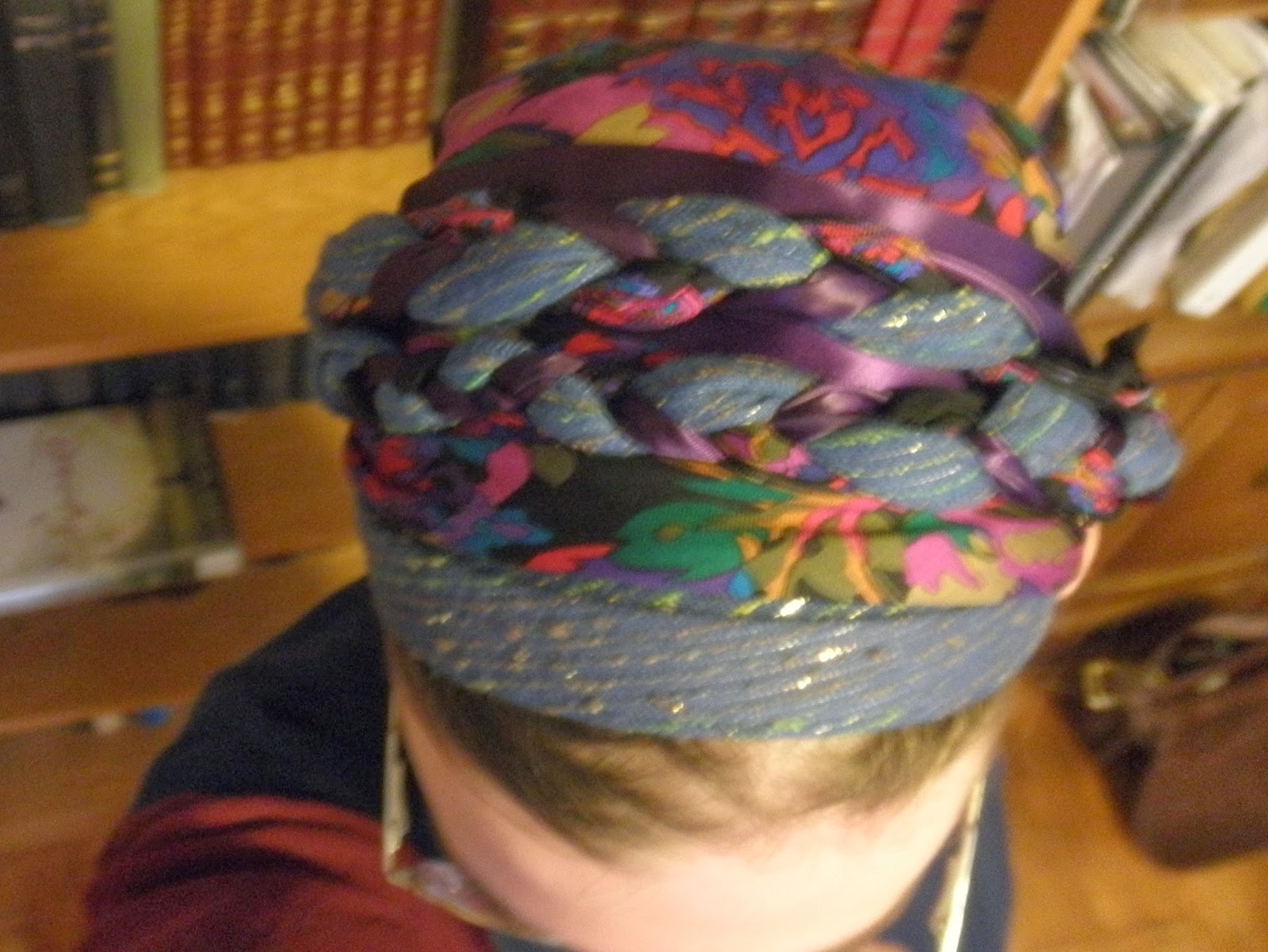
Now that I already posted a tutorial video for tichel heidi braids, here are some pictures of what the style actually looks like on me.
Here's one from Thanksgiving, with my Dad thrown in... This one is actually a little different- rather than layering two square scarves, I just put on the one, then took a narrow rectangular scarf, held it with the square scarf's tails and the ribbon, braided down both sides, and it worked out quite nicely.
And here are some earlier pictures, that didn't get up since I was computer-less for a while.
And here's a view from on top, so you can see the braids and their arrangement clearly.
And yet another day.
And here's still another one. Of course, they're all done with the same purple ribbon, since that's the one that I know is long enough. (It came off the wrapping of a wedding gift.)
On this one, I covered up the first scarf entirely, except for using the tails to braid with. It's a simpler, cleaner loo.
Here's one from Thanksgiving, with my Dad thrown in... This one is actually a little different- rather than layering two square scarves, I just put on the one, then took a narrow rectangular scarf, held it with the square scarf's tails and the ribbon, braided down both sides, and it worked out quite nicely.
And here are some earlier pictures, that didn't get up since I was computer-less for a while.
And here's a view from on top, so you can see the braids and their arrangement clearly.
And yet another day.
And here's still another one. Of course, they're all done with the same purple ribbon, since that's the one that I know is long enough. (It came off the wrapping of a wedding gift.)
On this one, I covered up the first scarf entirely, except for using the tails to braid with. It's a simpler, cleaner loo.
Thursday, December 12, 2013
Travel With Tichels: A Capsule Wardrobe
I dug this up in my drafts folder, and it seems pretty ready to go- so here's a mildly editted version of my writing from last year.
In my (admittedly limited) reading on style blogs, I've encountered the idea of a "capsule wardrobe" for travel- that by packing clothes in similar colors, you can pair things together in different ways, and create a bunch of different outfits with a minimum of stuff to schlep around. So I decided to experiment with the same idea with tichels.
So here are 9 varied styles, all done with just 3 scarves. 6 of them all use the same 2 scarves. Looking back, I see I did none with just the blue scarf and the white scarf. So there are another several variations available, which could break up the similarity of some of these looks quite a bit.
1. 2 scarves, the smaller as a headband, with the ends hanging loose.
2. The same 2 scarves, but with the smaller put on first, folded back over the second/larger scarf. The second scarf's ends brought up as a crown, and the smaller scarf's ends tied over my bun in a bow. (They could also be left down, twisted with the larger scarf's ends in the crown, or just wrapped plainly over the bun, or tucked under.)
3. Same scarves, braided together.
4. Ditto, with the braid brought over and around the bun.
5. No braid, but with the ends of the two scarves twisted together in two twists, and wrapped around the bun.
6. Same again, but instead of wrapping the twists around, they're twisted tighter, then bent to twist back around themselves at two lengths.
7. Three scarves, two put on as headbands/folded, and the ends braided together.
8. Each scarf put on just a smidge behind the other, then one end of each of the first two twisted together and brought over as a crown behind the third scarf. The rest of the ends are hanging (or could be stuffed back underneath), and could be secured with a clip, or a bow.
9. The second two scarves, layered over each other, and the ends brought up and over, each just behind the last.
The differences here are sometimes fairly subtle- but moving back and forth between combining different pairs of the three scarves in any of these different ways, with different profiles- I might alternate between an arrangement that has lots of hanging tails or braids first and then one that creates a lot of height, etc, to make the differences more dramatic. Switching which two scarves are used will also create more of a sense of variation.
Throwing in a fourth color scarf, or a couple of small embellishments (pin/headband/hairclip) will also make more distinction between styles.
Of course, do I listen to my own advice in this post when I pack? Almost never. Maybe some time soon I will though.
In my (admittedly limited) reading on style blogs, I've encountered the idea of a "capsule wardrobe" for travel- that by packing clothes in similar colors, you can pair things together in different ways, and create a bunch of different outfits with a minimum of stuff to schlep around. So I decided to experiment with the same idea with tichels.
So here are 9 varied styles, all done with just 3 scarves. 6 of them all use the same 2 scarves. Looking back, I see I did none with just the blue scarf and the white scarf. So there are another several variations available, which could break up the similarity of some of these looks quite a bit.
1. 2 scarves, the smaller as a headband, with the ends hanging loose.
2. The same 2 scarves, but with the smaller put on first, folded back over the second/larger scarf. The second scarf's ends brought up as a crown, and the smaller scarf's ends tied over my bun in a bow. (They could also be left down, twisted with the larger scarf's ends in the crown, or just wrapped plainly over the bun, or tucked under.)
3. Same scarves, braided together.
4. Ditto, with the braid brought over and around the bun.
5. No braid, but with the ends of the two scarves twisted together in two twists, and wrapped around the bun.
6. Same again, but instead of wrapping the twists around, they're twisted tighter, then bent to twist back around themselves at two lengths.
7. Three scarves, two put on as headbands/folded, and the ends braided together.
8. Each scarf put on just a smidge behind the other, then one end of each of the first two twisted together and brought over as a crown behind the third scarf. The rest of the ends are hanging (or could be stuffed back underneath), and could be secured with a clip, or a bow.
9. The second two scarves, layered over each other, and the ends brought up and over, each just behind the last.
The differences here are sometimes fairly subtle- but moving back and forth between combining different pairs of the three scarves in any of these different ways, with different profiles- I might alternate between an arrangement that has lots of hanging tails or braids first and then one that creates a lot of height, etc, to make the differences more dramatic. Switching which two scarves are used will also create more of a sense of variation.
Throwing in a fourth color scarf, or a couple of small embellishments (pin/headband/hairclip) will also make more distinction between styles.
Of course, do I listen to my own advice in this post when I pack? Almost never. Maybe some time soon I will though.
Subscribe to:
Posts (Atom)