Sunday, February 24, 2013

Some Recent Photos

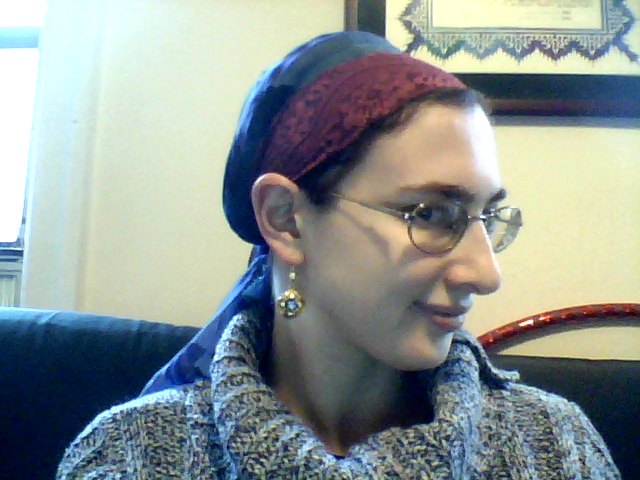
I've been a little neglectful of my daily self-portrait lately- life's been pretty busy and there are some stressful things going on.  Everything should quiet down soon, but in the meantime, here's what I've remembered to take...

 This is a triangular scarf, with a largish rectangle rolled up and tied around.  It worked really nicely for something so simple.


 I made this lace snood, but don't wear it out all that much, partially because arranging my hair in it so that it both looks the way I want it to and doesn't tangle itself enough to drive me to distraction is tricky.  Here I tried putting a scarf on underneath, which looked good, but seemed to defeat the point of a snood, I think.
I think this was a case of bright colors for a cloudy day...  It worked pretty well for me.
 And here's an old standard of mine that I hadn't done in a while- twists wrapped over my bun.  I like the way it feels.  This one has a smaller scarf added in the middle of my layering for color- but it didn't come out too clearly here.  I promise though, there's a smidge of light green and purple in there...

 And finally, down to today- I wore the same covering Friday night, only with a clip in the back over the bun, where I'll have to get my husband to photograph it somewhere soon.  I tried to turn around for the webcam, and I couldn't maneuver it quite right...

Monday, February 11, 2013

Our First Tefillin and Head-Covering Interview


I'm delighted to introduce to you this blog's first interviewee, who is also a friend who was something of a mentor to me in my religious practice in college.  


Who are you?  What do you do with your days?   
I'm Tovah.  I'm a wife, a mother, and a student.  I have been married for 5 and a half years.  My baby is almost 8 months old.  I am working towards my doctorate in biology, and have been doing that longer than I've been a wife and mother combined.


What brought you to start covering your head?
I have been covering my hair since I got married and covering my head in some way since my Bat Mitzvah.  At first, I wore a kippah when I wore my tallit and/or tefillin.  In college, I began wearing the kippah any time I was praying and later when I was eating, as well.  After college, I went to Israel for the year to study in Yeshivah.  I began to feel uncomfortable taking the kippah off at the end of the day, since Judaism did not stop when I stepped out the door, so I decided to start covering my head all the time.


How do you cover your head, and for what reason or reasons? 
When I first started covering my head, I wore a kippah, but I got negative attention when I was out and about in Jerusalem, so I decided to wear something less conspicuous.  I began wearing hats and scarves, but did so mostly with my hair loose, which was not how I was going to cover when married.  When I learned about the origins of hair covering for married women, it seemed to me that loose hair was the real issue, so when I got married, I kept my hair braided or in a bun if it was showing.  Since cutting my hair, I leave it loose, but am more strict about keeping it covered.  When it was long, I would occasionally take off my hat/scarf briefly to adjust it or if I was hot, so long as my hair was still "bound."  With my hair short, my hat/scarf stays on in public, and if I need to adjust, I find some privacy.
I cover my head to remind myself that Hashem is "above" me - similar to the reason for men to wear kippah.  I cover my hair because it is clear to me that the Torah expects a married woman to have some sort of covering or binding of her hair.  To me it symbolizes the extra modesty required of a married woman and is an indicator of status, much like a wedding ring in American society.


Do you think that covering is required?  If so, how much? 
I think covering is required, but I think how and how much are subject to much interpretation.


When did you start putting on tefillin?   What brought you to do so?
I have been putting on tefillin since my bat mitzvah.  I grew up in an egalitarian Conservative shul where many women wore tallit and a few put on tefillin.  I was given the choice, and chose to do so because it seemed to me to be better to do more mitzvot.  At that time, I went to shul only a few times a week and only put on tefillin when I went to shul.  I did not start putting on tefillin every day until the year I spent in Israel.


How do you find the combination of head covering and tefillin?  Do they feel complimentary, for you?  Oppositional?  Unrelated?   
When my hair was long and my main way to "cover" it was to keep it braided or in a bun, putting on tefillin was easy.  My hair would be up and I wore a kippah.  Once I cut my hair and decided that a kippah was not enough covering by itself in public, tefillin in shul got a little more complicated.  Now I wear a kippah under a loose-fitting hat.  I lift the hat up quickly to put the tefillin under it, keeping it over my hair the whole time.  Doing it this way feels a little uncomplimentary, but I'm usually more concerned about my hair being in my eyes or the straps of the tefillin shel rosh getting twisted.  At home, I still just wear a kippah with my tefillin since hair covering is a public issue while head covering is for all the time.


How did you come to your current combination?  Do any moments stand out that you’d share with us? 
When I first cut my hair, I tried wearing tefillin with a scarf draped over my head, but it was hard to keep that on.  I also experimented with threading the straps under a headband, but that didn't work at all.
I have had some difficult moments when away from home that I've forgotten to bring an appropriate hat to wear with the tefillin.  I had to cover with whatever I had in ways that weren't completely comfortable.


Do you have any tips or tricks to make the combination easier that you could share with us?
If you're going to go with a hat, try a bunch in private to find one that is comfortable over the tefillin.

Thursday, February 7, 2013

Volumizers

While my hair is quite long, it's also very fine, meaning that when I put my hair up in a bun, it doesn't support some styles of wrap- especially ones that have lots of layers going over the top of the head, or which want some bulk to create a sense of balance.  I've experimented with layering scarves underneath, as in this style:
And I've seen an excellent tutorial for using a long scarf and tucking it underneath itself, although I haven't managed to make it work for me.  I think I put my bun too low- but that's where it feels most comfortable and natural to me.

There are also commercial padded volumizers  sold, like these (pictures courtesy of Pesky Settler), and available online as well.


And then, there's the DIY approach, for which I found an interesting tutorial here.  It looks easy, and fairly cheap.  When I get the materials together, I'm going to try this one myself.  I'll let you know how it goes.

Do you bother with this?  What are your techniques?

Monday, February 4, 2013

A Couple of Links and My Thoughts

Here's another post with advice on what sorts of hats suit which face shapes.  I'm still looking for one that takes into account that you might want to put your hair up in the hat, but in the meantime, this is still helpful, I think.  However, I'd have to actually figure out my face shape in order to understand the advice.  I've read the descriptions and they always baffle me a bit.

And another perspective on adjusting to covering your head or hair.  Melissa's very intentional gradual transition connected to me to my own experience of engagement very strongly.  Here I was, "off the market" and yet not yet married, and feeling like it was an appropriate time to start playing with the equivalent of an engagement ring on my head.  Of course, I already covered partially, for other reasons, but already at that point, it made me start thinking of my caps and headbands as double-purpose coverings.  It also meant that I already had lots of practice in thinking about how to get scarves to stay on my head by the time I got married.

Here's a personal reflection about hair covering through the course of a marriage, divorce and up-coming remarriage.  It isn't something I've really touched on, in this blog, and I really appreciated the perspective.  I think you will too.  Here's the same author's thoughts shortly after her divorce.  A lot of attention around women's head covering gets put into newlyweds and engaged women contemplating this practice.  Very little that I've seen goes into talking about divorce, loss and other changes that are less pleasant and exciting.  But that's part of a full and authentic look at any religious practice- how does it interface with the whole life?  I'm grateful for these posts opening up that door for me to look inside.

Sunday, February 3, 2013

I'm A Star!

I've been featured at Wrapunzel, as this week's Lady Wrapstar.  Check out both some photos and an interview over there!  (And check out the blog while you're there- Andrea has some dynamite ideas, and some great how-to videos.)

Thursday, January 31, 2013

The Other Side of the Coin

Sometimes, head-covering isn't as easy, or even as possible, as it's been for me.  Here is one woman's story about her love and hate relationship with covering her hair.

She talks about a few different problems.  I'm going to share my read of her issues, and then my own thoughts about them.

1. We pressure people into doing things the same way, regardless of how things work for different people.
I agree.  There are a lot of different ways to practice Judaism, and even a lot of ways to practice and be Orthodox.  The fact that our communities tend to push for uniformity is a social problem, though, not one having to do, specifically, with head covering.  It's also about tznius in general, and where we send our kids to school, and to camp, and how often we go to Israel, and a Ton of other things that really bother me about the Jewish community.

2. It's hard to cover your head, because the things tilt and slide and get uncomfortable.
I haven't found it that hard, but I had the head start of wearing assorted partial-head coverings (kippot, headbands, smaller scarves) for years before I got married.  It's something that I really value.  It also made adjusting to a fuller covering, and keeping one on, a lot easier.  Clips help too, and other folks use velvet headbands and nylon caps, sometimes made from the top of a pair of pantyhose.  There are lots of tricks, but, like many mitzvot that are new to you, this one does take some adjusting to.  So did putting on tefillin, when I started.  So did wearing a tallit.  So did managing to hold a lulav, an etrog and a siddur in only two hands.

3. It's expensive- either you're buying lots of scarves and hats, or (even more expensive) you're buying at least one wig, if not more than one.
Like anything, this depends on your budget, and how you feel comfortable shopping.  My first scarves were ones my mother and grandmother had had for years and never worn much.  I've made my own caps from crochet string and doily patterns (string is about 3.50 for 400 yards, which makes more than one cap, and you can get free patterns online, and adapt a bit).  Other scarves have come from Goodwill and similar sources.  If you're willing to be flexible, you can do this for not too much money.

Unless, of course, you want, or need, to wear a wig.  Then it is absolutely expensive, and difficult to budget, and even more difficult to rationalize, especially if you hold by the rabbis who say that it isn't necessary.  But then, most of the rabbis who say that are Sefardim, and generally only Ashkenazim permit wearing wigs, so you can go one way or the other, but probably not both, unless you're willing to do some picking and choosing.  You might be.  I might be.  (Don't tell my husband, he might get his hopes up about getting to eat kitniyot again...)

4. It changes the way you look to the people who know you already, and to yourself.
Sure it does.  And that's an adjustment.  I recognize that while I was looking forward to getting to cover, not everyone does- nor does every husband/parent/sibling/friend.  There's no getting around it.  But a lot of things change when you go through life transitions.  Maybe it's most important for newlyweds to have a physical marker, while the social adaptation is still catching up.  Maybe it isn't worth it if it causes that much discomfort.  I don't know.

5.  Probably most importantly, headaches.
This is a very good reason not to cover, or to find some less restrictive way of covering.  I think there are ways out there, and ways to adjust.  But if that doesn't work- there are permissive rulings out there, go out and uncover your head if you get migraines.

6. No one in our grandmothers' generation did it- so why should we put so much pressure on ourselves to cover?  If it's really a mitzvah, why didn't our grandmothers think so?
This is a major question of American Jewish sociology.  American society was much less accepting of ethnic and religious difference before the 1960s.  To quote one of my college professors, Sylvia Barack Fishman, "People realized that if Black was beautiful, then maybe Jewish was mildly attractive".  When our grandmothers were getting married, it wasn't acceptable in general society.  Orthodox Jewish men didn't wear kippot outside, for the most part.  Many, many more observant Jews ate cold dairy in non-kosher restaurants without feeling bad about it.  Young Israels had dinner dances with mixed dancing for their members.  Not to mention that Hashkamah minyanim started as the way men could go to shabbos davening and still make it to work on time.

On other words, we have religious freedoms in the social realm that our grandparents never dreamed of.   There was a lot of pressure Not to look un-American, not to look different.  And by the time things changed- well, if you'd already been married for 20 years, and now there was this new freedom- well, that's a long time to have built an image of yourself as a married woman, as an adult, as a mother, even.  It isn't one of those lifecycle transition moments.  I can see why even in communities where every newly married woman starts covering every inch of hair on her head, her grandmother still comes to shul and puts on a doily, or nothing at all.

7. What about intermediate options?
I am totally with her on this one.  I like covering all my hair, but I don't always cover all of it.  (For example, here.)  I'm still not sure what the halakhic requirement is, or rather, which set of requirements I follow.  There are plenty of different ways of looking at head covering, pick the one that works for you.

It ties into that first issue- there's pressure to do it the way that everyone else in your community does, or the way that the people you think are most authentic do, or whatever else is pressing on you.  It's one of those precious challenges, and a way to work on your own autonomy.

Tuesday, January 29, 2013

Rambam on Men's Clothing and Headwear

Coming back to men's or ritual headcovering, after a break, here's the Rambam, discussing how one should dress for prayer.  So here we're in Egypt, between 1170 and 1180 in the Mishneh Torah.

Mishneh Torah, Hilkhot Tefillah 5:5
תקון המלבישים כיצד? מתקן מלבושיו תחילה ומציין עצמו ומהדר שנאמר "השתחוו לה' בהדרת  קודש".
  ולא יעמוד בתחילה 
באפונדתו ולא בראש מגולה ולא ברגליים מגולות אם דרך אנשי המקום שלא יעמדו בפני הגדולים אלא בבתי הרגלים

Translation:  The standard arrangement [literally: fixture] of one's clothes (when one prays), what is it?
One should arrange his clothes first, and then he should distinguish himself and beautify [literally, glorify], as it says "bow down to God in the glory of holiness".  And in an ideal circumstance, he should not appear with his purse, and not with an uncovered head, and not barefoot, if the way of the people of the place is not to stand before the great without something covering their feet.

Commentary: Head covering for prayer here is connected with other ways that one "dresses up", it's a demonstration of formality and respect for God, in the same way that dressing formally (or, here, wearing shoes) displays respect for people in authority.  This is wearing a hat the way that one wore a hat for all respectable occasions until sometime around the 1960s.  It would be fair to say that it isn't a separate aspect of one's wardrobe that has a purely devotional purpose.  We're talking about being appropriately dressed for a respectable environment.

I find it interesting, however, that the requirement for shoes and/or socks is qualified, and the requirement for a head-covering isn't.  You can go barefoot (or in sandals) for prayer if people walk barefoot/sandal-shod in formal situations.  But head-covering doesn't get that qualification.  That takes something away from my previous paragraph- there is Something about a covered head that implies respect, even if it isn't part of the regular dress code for respectable dressing.  There's something special about it that isn't getting defined here, but there's a hint.  I wonder if any of the nosei keilim on this passage pick up on it...  But that will have to be a post for another day.

Sunday, January 27, 2013

Another Week Goes By

Sunday: (Scarf and scrunchie)
 Monday: (two scarves- the bottom one is tucked in to make sure my bun doesn't come out, the top one makes a "ponytail", and the tails of both are twisted and wrapped around my bun and the ponytail.
Tuesday:
This is a new style- I used this step-by-step tutorial to take my second scarf (a fairly thin rectangle) and make a braid down one side, then I positioned it over my first scarf so that the braid ran down the side of my head.  I left both sets of tails hanging, and the lengths worked out to layer nicely.  I wish the pictures were a little clearer- maybe I'll attempt better photography with this style sometime soon.
\
Wednesday we had an alarm-clock mishap, so I never got a photo.  So here's Thursday (a day of working at home, relaxing, and a show/presentation in the evening):

And Friday:  This is the same style as Tuesday, only with all my ends tucked in.  It's a slightly different look.  I'm still experimenting, and hoping to put together a how-to video sometime soon.

Also, look forward to some links and reactions coming fairly soon!

Tuesday, January 22, 2013

Keeping It Simple This (Last) Week

Here's my slightly belated photos from last week.  Enjoy!

Sunday (obviously, a working Sunday): I liked the way the very simplest way of tying my scarf actually suited  the outfit nicely.
And a second photo, just because:
 Monday:
 Tuesday: (In which I wrap very simply, because I wanted attention on my vest, not my head- wearing the vest on its own, rather than with the blazer I wore on Monday was an experiment)
Wednesday: Here I strayed from "keeping it simple" and did a two-layer combination, with only one end of the long underscarf showing, braided up with the ends of the (square, folded to a triangle) over scarf.
Thursday: Inspired by Wednesday, I did another braid- but wrapped it up over my bun.  I hooked my additional 2 small scarves for the braid over my bun, tied once beneath, and braided away, then wrapped the whole thing over the bun, for something that looks simpler than it is.  It's a little hard to see, but hopefully this gives you a taste:
Friday: (a day off): (A small triangular scarf, with the ends tucked in, and a scrunchie around it, although it's hard to see it here, in tribute to Andrea's discussion of using scrunchies in headcoverings.

Sunday, January 20, 2013

What Do You Get From Covering?

This post about wearing hijab is really very thoughtful, while still being an easy read.  I think a lot of it holds true for Jewish (married-woman style) head covering too.  Here's my favorite line: "Although nobody on the outside could see my hair, my appearance underneath can still hold as much significance as I want to give it."  My image of myself is both ways that I see myself in the mirror- hair covered (in all its different silhouettes) and uncovered and loose and down past my waist.  It's as important to me as it ever was- even if none of you ever see it again.  

The other thought I wanted to draw out is "I choose who sees what’s under there and that gives me a sense of power and reassurance I wouldn’t trade for anything".  Clearly, it doesn't speak so much to wearing a kippah, but it's an interesting set of ideas to think about.  Much of what's said could go for any modesty practice, but there's something about choosing to cover a part of the body that isn't in the secular vocabulary that is particularly vocal- especially, for me, in speaking to myself.  It's a message that I hear most from my head covering, far more than the rest of my modesty-fueled clothing choices.