I came across this short illustrated guide to Hasidic women's head-coverings, and thought t would be a good way to get back to posting here...
Here it is: Shpitzels, frisettes, sheitls, and more
I'm interested in the differences between the various sorts of small amounts of false hair that are delineated here- especially how restrained false hair is labeled so differently from loose false hair. I'd love photos as well as the illustrations, but they do make the differentiation very clear. I partiularly love the note at the end, about wigs: "The last is considerate very liberal headgear in Williamsburg, and women are often asked not to enter a synagogue uncovered."
In the meantime, I've added a new blog project that has been getting a bunch of my attention during the little one's naps- Nursing At Shul, where I'm putting out information that people share with me about breastfeeding in the synagogues they go to.
I've been camera-less for a while, but it has recently been restored to me, so hopefully we'll be back in business" with both photos and textual content.
Showing posts with label Jewish ethnicity. Show all posts
Showing posts with label Jewish ethnicity. Show all posts
Friday, June 5, 2015

Thursday, August 23, 2012
Historical Head-Covering: Yemenite Wedding Headdresses
We're off to another wedding tonight, so in its honor, here's a post about Yemenite Jewish wedding head coverings. These are much more exciting than (the future post of) what I wore to a wedding... Enjoy!
When I started to research Yemenite Jewish head coverings, I fell into the trap of presuming that there was one standard Yemenite Jewish style of dress. Instead, I found that the images in my mind, particularly of Yemenite bridal headdresses are actually the way that brides in Sana'a were dressed, and that different regions had different customs. The ethnic diversity of Jewish customs in fact was even more diverse than I had set out to demonstrate. So take all of this as a general statement, rather than a description of all the details of how Jewish women all over Yemen used to dress for their weddings.
There was even one set of photographs that came up again and again, showing tishbuk lulu, the Sana'a wedding headdress, on a variety of websites- apparently the standard photo of a Jewish Yemenite bride. These headdresses are frequently also bedecked with flowers and rue leaves.


In contrast to these couple of extraordinarily elaborate photos, some more searching revealed others with very different styling. Instead of a high, pointed headdress, some of the other regions seem to show brides with hood-like headdresses, or with decorations that come down onto the forehead.

Thanks for this set of photos goes to http://www.hennabysienna.com/yemen.html. The same page also has a historical picture of Sana'a's wedding headdress.
I also found the interesting note that new mothers also wore (at least in some part(s) of Yemen) a headdress similar to that of a bride.
This has all been internet research- I hope to have a chance to do more formal research and to share it with you, at some point in the future.
When I started to research Yemenite Jewish head coverings, I fell into the trap of presuming that there was one standard Yemenite Jewish style of dress. Instead, I found that the images in my mind, particularly of Yemenite bridal headdresses are actually the way that brides in Sana'a were dressed, and that different regions had different customs. The ethnic diversity of Jewish customs in fact was even more diverse than I had set out to demonstrate. So take all of this as a general statement, rather than a description of all the details of how Jewish women all over Yemen used to dress for their weddings.
There was even one set of photographs that came up again and again, showing tishbuk lulu, the Sana'a wedding headdress, on a variety of websites- apparently the standard photo of a Jewish Yemenite bride. These headdresses are frequently also bedecked with flowers and rue leaves.


In contrast to these couple of extraordinarily elaborate photos, some more searching revealed others with very different styling. Instead of a high, pointed headdress, some of the other regions seem to show brides with hood-like headdresses, or with decorations that come down onto the forehead.

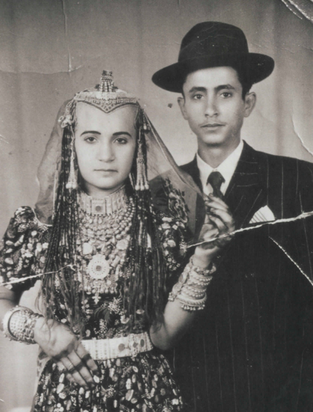
Thanks for this set of photos goes to http://www.hennabysienna.com/yemen.html. The same page also has a historical picture of Sana'a's wedding headdress.
I also found the interesting note that new mothers also wore (at least in some part(s) of Yemen) a headdress similar to that of a bride.
This has all been internet research- I hope to have a chance to do more formal research and to share it with you, at some point in the future.
Monday, August 20, 2012
A Very Little Research Lends Me Perspective
I've been researching head coverings from different Jewish communities around the world. It's amazing how much context it is lending to the way I'm seeing contemporary Jewish head coverings, right now.
Looking at historical head coverings, they vary regionally. Now, they vary fairly little by region, and more by "how frum you are". The communities aren't local, they're almost hierarchical. Modern Orthodox women wear this, Hareidi women wear that, etc.
The same goes for men. You may have heard the joke describing how to identify a man's Jewish affiliation by where he wears his kippah (the image slides up the head- Reform at the very back of the head, near the top of the neck; Conservative a little higher, but still slanted toward the back; Modern Orthodox flat on top; Yeshivish tipped forwards toward the forehead). Similarly, there are identifiers like this chart (you'll need to scroll down a bit) from Wikipedia, where different materials are used to identify "how frum" a man is. (I joke that I could wear any of them and send the same message- you put a kippah on a woman, and all its other contextual messages go flying out the window...)
In some ways, I am making use of this set of stereotypes. By covering my head like someone from a "frummer" community than my own, I reach into that sort of authority that stems from a communal respect for "authenticity". On the other hand, it makes me seem somewhat separate from "my own" community in some ways, and leads to concerns like the ones I've shared about how I'll be seen in professional contexts.
Something about the modern, global world makes community into a statement of belief and lifestyle, rather than an affiliation with the people who live near you. My local Jewish community consists of a folks with all sorts of different practices and observances. There's no way to tell where I'm from based on how I dress. But you can tell something about what religious perspectives I stand for, just by looking at me.
It's a force for homogenization in how we dress- and a shift in what parts of our identities we express visually. I wonder what it would be like to wear what American Jewish women wear on their heads, rather than what a certain sort of observant Jewish women wear on their heads. Would it feel different? Would I notice? Would I feel more or less constrainted in my choices and creativity than I do now?
Looking at historical head coverings, they vary regionally. Now, they vary fairly little by region, and more by "how frum you are". The communities aren't local, they're almost hierarchical. Modern Orthodox women wear this, Hareidi women wear that, etc.
The same goes for men. You may have heard the joke describing how to identify a man's Jewish affiliation by where he wears his kippah (the image slides up the head- Reform at the very back of the head, near the top of the neck; Conservative a little higher, but still slanted toward the back; Modern Orthodox flat on top; Yeshivish tipped forwards toward the forehead). Similarly, there are identifiers like this chart (you'll need to scroll down a bit) from Wikipedia, where different materials are used to identify "how frum" a man is. (I joke that I could wear any of them and send the same message- you put a kippah on a woman, and all its other contextual messages go flying out the window...)
In some ways, I am making use of this set of stereotypes. By covering my head like someone from a "frummer" community than my own, I reach into that sort of authority that stems from a communal respect for "authenticity". On the other hand, it makes me seem somewhat separate from "my own" community in some ways, and leads to concerns like the ones I've shared about how I'll be seen in professional contexts.
Something about the modern, global world makes community into a statement of belief and lifestyle, rather than an affiliation with the people who live near you. My local Jewish community consists of a folks with all sorts of different practices and observances. There's no way to tell where I'm from based on how I dress. But you can tell something about what religious perspectives I stand for, just by looking at me.
It's a force for homogenization in how we dress- and a shift in what parts of our identities we express visually. I wonder what it would be like to wear what American Jewish women wear on their heads, rather than what a certain sort of observant Jewish women wear on their heads. Would it feel different? Would I notice? Would I feel more or less constrainted in my choices and creativity than I do now?
Subscribe to:
Posts (Atom)