Showing posts with label historical headcovering. Show all posts

Monday, August 11, 2014

Historical Head-Coverings: The Sarma, Algerian Jewish Women's Head-Covering


The Sarma was made of a metal piece with a tall front that could project up to a meter tall, with pieces that fit the sides and the top of head.  Accounts of it date back to 1730.  It was made out of metal lace, which I read was made by cutting away pieces of metal, which made it somewhat cooler and lighter-weight than solid metal pieces would be.  Other images certainly seem to suggest that the metal was shaped into lacework, rather than being made of cut-outs.


It was fastened to head with scarves and strips of fabric.  A woman would place the first one over her forehead and she would tie it at the back of her head.  The second would be placed under the chin, and the ends would be brought up and tied over her head.  A third scarf,  long and narrow, would wing around the base before hanging in two ribbons down the back.  These tails or ribbons would hang all the way to the feet.

At home it was worn uncovered (as much as having three scarves wrapped around your head in various directions qualifies as uncovered), but women would put another shawl over all of this for outdoors.  The illustrations that I've seen show that shawl as a thin, even translucent piece of fabric with what looks like embroidery on it.  It looks gorgeous.  Some women, believe it or not, even slept in their sarma.  It doesn't sound comfortable to me.

Some accounts say that at least in the early 20th century,- unmarried girls, once mature, would also wear the sarma, only with some sort of flower-shaped "tremblers" added to indicate their available status.  I haven't found any pictures of those yet.

I'd love to know how this style developed, but again, no information there yet.  One of the odd things about this research is that there is very little that I can find available online, as of yet.  As usual, as I find more information, I'll definitely be sharing it here.

Information in this post comes primarily from The Jewish Wardrobe: From the Collection of The Israel Museum, Jerusalem, ed. Esther Juhasz and A History of Jewish Costume, by Alfred Rubens.  


Thursday, December 26, 2013

Historical Head Covering: Mehdor

Since some of us have a little more time this week- I seem to be upping the blogging schedule.  Here's some pretty interesting information about the Mehdor, a Jewish women's head covering from Morocco.

The Mehdor was made out of silver wire and horsehair or cattlehair.  It was basically a combination of a wig and an ornament/hat combination.  The mehdor was the most elaborate of Moroccan women’s headdresses, but it was worn daily in one region of the country.  It would cover a woman's head from ear-to-ear in front, with two forelocks of "woven hair" visible.  Basically, it came with it's own bit of "wig" in the front.  These bands would then be gathered into braids (after/behind the visible part) which tied the mehdor onto the woman's head.

(In this image, you can see that the "hair" in front is part of the mehdor.)

On festive occasions, women would add a red silk scarf- called a feshtul- trailing down the back behind the mehdor.  Affluent women would then add pearl tiara- called a tasfift- over it.  (This tasfift is related to styles worn by Spanish Jews, and shows a connection and impact between the two Jewish cultures.)  Over it all a they might add another scarf, called a sebniyya- which would fully conceal the mehdor itself.

(This is an image of a woman wearing a tasfift.)

Creating a mehdor was a collaborative process.  First, a silversmith would arrange cattle-tail hair lengthwise, and bind bundles of it with silver wire.  He would then attach vertical silver tubular half-cylinders to this base, which were also decorated with enamel cloisonné and inlaid with colorful beads.  After that, seamstresses added a padded, layered cotton lining with a cylindrical thickened edge at top.  (This gave it shaping.)

Like a number of other historical head coverings (like the Shterntikhl in Eastern Europe, for example) it was used to display family’s wealth.

Wednesday, December 25, 2013

Where Google Can't Provide

I've been working on some more historical headcovering posts- and I'm finding that this is one area where Google image searches, or Google searches of pretty much any sort, are not coming up with anything.  I think I've finally found an area too arcane for Google and the internet of 2013-almost-2014.

Pinterest has been a bit better, oddly.  I've found some great images there, by searching for the name of a photographer who took many photos of Jewish women in northern Africa in the 1930s, but there are several topics that I've done some writing about, and can't find any images.  (There were some excellent ones in the books I was using at the JTS library.)

It's oddly frustrating- here's this area that I'm interested in, and the internet actually can't provide for me.  (This is highly reminiscent of my luck with research projects as a kid.  My first research project in 4th grade was about the kibbutz, and the only sources I found between school and synagogue library were 1. a film strip, 2. a children's book for little kids, and 3. an adult book about the organization and governance of kibbutzim that was rather above my head.  Nevertheless, I wrote a 10 page paper- Lord only knows how.)

It's also strange to think that I'm googling images of a women's head covering that was still worn not much more than a century ago, and come up with lots of pictures of some sort of stuffed cabbage.  (Really. Truly.)

With those enticing thoughts, I leave you.


Wednesday, December 4, 2013

Historical Head Covering: The Grun

The grun is one of the more distinctive Jewish head coverings that I've come across.  It was worn by married women in the Atlas Mountains.  Grun means horns, and looking at it, you can see why.
(The woman on the left is wearing the grun.  The images in this post are the work of Jean Besancenot, who took them around the 1930s.)

The grun is made up of several parts:
1. Two coils of thick goat’s hair yarn were attached at sides.  This formed the basic structure.
2. This was covered with a hood called bniqa, which was colorful, although not much was seen by the time the whole grun was assembled.
3. What I read was that it was wrapped in swalf- card-woven band of coton and metal thread with two locks of black fake-hair hanging down.  The middle of the swalf had colorful rows of beads and a tiny gold pendant dividing the fake hair into 2 segments.  However, I'm not seeing a swalf in these pictures, although I do see fake hair in another image of the grun on pinterest, but can't add it here for some reason.  If you want to see it, here's the link.
Afluent women would add 4. Long band called mehmel- identical to swalf but without the locks of fake hair, wrapped around the horns of the grun.  The size would prevent women from carrying things on their heads, as was the local practice.

On top of all of that, women would wear an additional 5th piece-  a cover-scarf.  The fancier one for Shabbat and holidays was called a sebniyya del-ghta, and made of silk with tassels.  For weekdays, the cover scarf was white cotton scarf dotted with colorful patterns, and called an izar del-ghta.

The grun was first worn 8 days after wedding, and was put on for the first time with a special ceremony led by a married woman who had never been divorced or widowed.  Afterward, it was worn daily.  Some Jews believed it had fertility-enhancing powers. I don't quite get that, but there it is.

 The information in this post comes primarily from two sources: The Jewish Wardrobe: From the Collection of The Israel Museum, Jerusalem, ed. Esther Juhasz and A History of Jewish Costume, by Alfred Rubens.  

Wednesday, November 27, 2013

Chag Urim Sameach, Happy (Anticipatory) Thanksgiving, And More

Dear Readers (I've been re-reading Isaac Asimov, hence the opening),

My computer died a few days ago. I hope to maintain a regular posting schedule anyway in the interim, but please be forgiving.

 In other news, I've been doing some really exciting library research to be able to return to my Historical Head Covering series again soon. There are so very many different styles of Jewish head-covering out there, some of them quite, quite unexpected. I've found the (Turkish/Ottoman) precursor to the modern volumizer, a covering that looks like a little girl's princess hat, only prettier, wigs or pieces of fake hair made from silk thread in North Africa, and styles that were first enforced by law, then had to be legislated away because the people refused to stop wearing them. Also, a lot about men's turbans and the meaning of their colors.

I hope I've gotten you a little excited about what's to come.

But I wonder about the plausibility of wearing things inspired by some of these historical fashions. Is borrowing from the past as inappropriate as borrowing from other contemporary cultures? How appropriate is it to borrow from Jewish cultures that aren't your own ethnic background?

 It reminds me of my teenage angst over whether to identify myself on various forms as white/Caucasian or as Jewish (a write-in, obviously). My reasoning at the time was that I identified more with other Jews, no matter what their ethnicity, than I did with people who shared my skin color. Now obviously, that isn't what statisticians are looking for when they are analyzing standardized test scores.  Similarly, the people who get say over who can be part of their group are the group itself, not the people asking for admission.

 But when the question is- which group affiliation is dominant- religious community (which dictates the practice that is shared) or ethnic community (which dictates the style that someone wants to copy), how do those things interact?

 Does the passage of time change any of these factors? Do I still have ownership and identity connections to a style my great-great-great grandmother last wore, and which I likely have never heard of or seen? What if I've seen it in a museum?

 A lot of questions, no real answers. If you have thoughts, as always, I'd love to hear them.

Thursday, January 17, 2013

Not Quite Related- But Too Cool To Pass Up Sharing

This piece on the hair style and headdress of the Roman Vestal Virgins is not exactly related to Jewish head covering, but just too cool and interesting to pass up sharing with you.  There's a video showing a recreation of how the vestal virgins probably braided their hair, and the coverings that went over that hair-do.

There are a couple aspects of the style that look quite lovely- particularly the wrapping of hair around a structural element (here, basically a soft rope), in front of the covering.  It would be a way of styling what hair one might show at the front of your head that wouldn't show too much hair for (my) comfort.  However, this seems like an area where there might be real concern about copying the practices of idolaters.

Here's the research: We started hunting: Masekhet Shabbat סז on darchei ha'emori brought us to the Rambam Hilkhot Avodah Zarah 11:1, which prohibited wearing haircuts that were particular to practitioners of avodah zara.  From there, to an aggada in the gemara in Sotah and Bava Kama (:פב).

We then checked out the Tur, and finally the Shulhan Arukh, where the Rema tells us that copying gentile haircuts is permissible when it serves a useful function, such as identifying one as a doctor.  However, anything associated with pritzut (licentiousness) is forbidden.  So far, none of this Quite touches our issue, which is hairdressing rather than haircuts, but nevertheless, so far we have neither a particular use to permit, nor any licentiousness to forbid.  The issue of temporal dislocation (i.e. there haven't been any vestal virgins in hundreds if not thousands of years) hasn't been addressed yet either.

I haven't finished the research yet, but I'll throw the question open for social debate.   From hair cut to hair style, at what point does emulating an idolatrous style start to wig you out (you should pardon the pun)?


Thursday, August 23, 2012

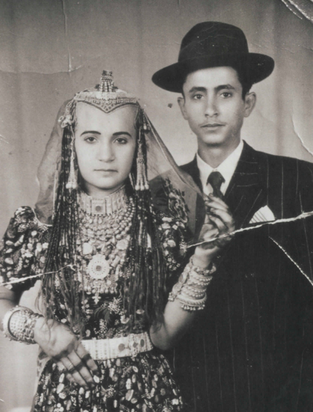
Historical Head-Covering: Yemenite Wedding Headdresses

We're off to another wedding tonight, so in its honor, here's a post about Yemenite Jewish wedding head coverings.  These are much more exciting than (the future post of) what I wore to a wedding...  Enjoy!

When I started to research Yemenite Jewish head coverings, I fell into the trap of presuming that there was one standard Yemenite Jewish style of dress.  Instead, I found that the images in my mind, particularly of Yemenite bridal headdresses are actually the way that brides in Sana'a were dressed, and that different regions had different customs.  The ethnic diversity of Jewish customs in fact was even more diverse than I had set out to demonstrate.  So take all of this as a general statement, rather than a description of all the details of how Jewish women all over Yemen used to dress for their weddings.

There was even one set of photographs that came up again and again, showing tishbuk lulu, the Sana'a wedding headdress, on a variety of websites- apparently the standard photo of a Jewish Yemenite bride.  These headdresses are frequently also bedecked with flowers and rue leaves.

 In contrast to these couple of extraordinarily elaborate photos, some more searching revealed others with very different styling.  Instead of a high, pointed headdress, some of the other regions seem to show brides with hood-like headdresses, or with decorations that come down onto the forehead.


Thanks for this set of photos goes to http://www.hennabysienna.com/yemen.html.  The same page also has a historical picture of Sana'a's wedding headdress.

I also found the interesting note that new mothers also wore (at least in some part(s) of Yemen) a headdress similar to that of a bride.

This has all been internet research- I hope to have a chance to do more formal research and to share it with you, at some point in the future.

Sunday, August 12, 2012

What is a Shterntikhl? Historical Head Coverings, Part 1

We're off to a wedding this afternoon.  In honor of it, I thought I'd share this piece about fancy head coverings from the Jewish communities of Eastern Europe.

The fanciest headdress of Polish Jewish women was the shterntikhl and its variation inLithuania known as the binda. Worn only on special occasions, this was an expensive article, decorated with precious stones that emphasized the owner’s status. It was first used during the late eighteenth century and became popular in the nineteenth; some families possessed one (though it was no longer worn) until the interwar period. Yisroel Aksenfeld’s short novel Dos shterntikhl (1862) notes that “on Simḥat Torah, when wealthy women go to kiss the Torah, they wear shterntikhlekh.” The shterntikhl was composed of two bands with precious stones and pearls sewn onto them, encircling the head. Both bands were stiff and sewn above the forehead. The upper part was usually simple and formed a diadem, while the lower part, with a zigzag edge, encircled the face closely and reached beyond the ears. Long earrings accompanied this type of headdress. A more modest version was worn as late as the early twentieth century—a stiff diadem placed over the forehead. This was a band of material lavishly decorated with embroidery and pearls, which used ribbons to tie it in the back. 
From http://www.yivoencyclopedia.org/article.aspx/Dress (If you check out the link, there's a great picture of a shterntikhl- it's the first picture in the entry.)

The  article describes a variety of different sorts of head coverings from different eras, and for different occasions.  I look forward to sharing some more snippets from this article, as well as finding some more information to share about the way that some of our ancestors dressed.  This one certainly seems festive, and involves less fuss (but also less creativity) than what I will put together for a head covering, when going to a wedding...