Every once in a while, I get an awkward comment about my scarf. The latest (of a pretty small number) was from a patient at work. She said something like "it's too bad that you wear that- you're such a pretty girl". I was a little surprised, but found something to say fairly quickly. My response: "actually, I find it very meaningful".
I'm not sure that that was the most useful pastoral response- in fact, keeping something focused on her would, I'm sure, have been better. But socially, I think it was a pretty decent response, simple and to the point.
I've read, frequently, (and experienced some mild spin-off comments) about people who presume that one covers "because your husband makes you". And for me (and most of the women I've talked to) that is very much not the case. My husband is supportive of what I do- but would never have asked it of me, and would be equally supportive if I did just what I did before we got married, or anything in between that and this. (The one thing I think he was once uncomfortable with was seeing me with a regular/men's sized kippah, before we were married, once. And I don't know that that would bother him at home, any more. I don't know. It looks a little odd on me to myself, these days, honestly. I'm not used to it on myself anymore.)
Do any of you cover (or modify your dress) because your husband/partner really wants it, when you don't or don't particularly care?
Saturday, October 6, 2012

Wednesday, October 3, 2012
Recreating A Recent Shabbos Style
So I should be going to bed, but instead- here's a recreation of a covering I put together for a recent shabbos, and had no time to photograph...
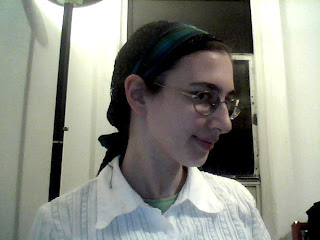 And here it is from the back (except that the tails go a bit longer):
 I occasionally miss having something long to hold onto behind my back (a habit when I was thinking or praying, from before I was married), and this definitely gave me that sense of something on my back... It was also a fun change because the tichel itself (a triangular shawl, folded over because it's rather large) isn't tied at all, just draped over my head and bobby-pinned on. The ribbon is tied around it (with my bun above the bow), and that brings the scarf together. It actually held up just fine that way...
The only problem? My shadow looked a little bit like the bride of Frankenstein- the bow made a shadow that looked like two bolts sticking out of my neck... Too bad I couldn't get a picture.


The only problem? My shadow looked a little bit like the bride of Frankenstein- the bow made a shadow that looked like two bolts sticking out of my neck... Too bad I couldn't get a picture.
Wednesday, September 26, 2012
Post Yom Kippur Musing
Now that Yom Kippur is over (and my husband isn't home yet- he was away leading services elsewhere, I was home), I've been thinking about how to dress for Yom Kippur. There's the "it's a holiday, we should look festive" approach, and there's the "it's Yom Kippur, it's totally Not about how you look, white is useful, wear whatever you have that's white" approach. I tend toward the latter camp, but this year, felt mildly uncertain about it- maybe I should do something to dress up a bit more... Especially since I'm pale enough to look a little washed out and well, very much on the ascetic side of things, all in white.


Thursday, September 20, 2012
Shana Tovah/G'mar Tov: Catching Up
Hey Folks,
I'm still finding my rhythm with my job- especially with the holidays now. So posting may be rather sporadic until things calm down and I really settle in. I'm still thinking about all the things that this blog ought to have on it- there will be a return, eventually, to source texts, and to some history and sociology of Jewish headgear in various Jewish communities, along with some photos...
In the meantime, here's a quick news article about women's head-covering, sort of as an interfaith phenomenon.
I'm still finding my rhythm with my job- especially with the holidays now. So posting may be rather sporadic until things calm down and I really settle in. I'm still thinking about all the things that this blog ought to have on it- there will be a return, eventually, to source texts, and to some history and sociology of Jewish headgear in various Jewish communities, along with some photos...
In the meantime, here's a quick news article about women's head-covering, sort of as an interfaith phenomenon.
Thursday, September 13, 2012
Follow-Up On Work Anxieties
After the
concerns I wrote about before starting work, you might be surprised at the
outcome. Although I’d contemplated trying
to make my covering less obtrusive, rather unsurprisingly I went into work in my
usual sort of head-coverings, and have had no trouble or discomfort about
them. Neither supervisor seems at all taken aback or
discomfited.
It seems
that I pinned my anxieties on an item of dress, when their concerns seem to
have rested somewhere else entirely- in some aspect of scheduling or behavior
that my dress indicated, rather than in the outfit itself. I was even aware of that at the time of my
interview.
I don’t know
why I fixated on my tichel as the source of their concern- in retrospect, it
seems a little bit silly. I suppose that
I grasped onto the physical item that seemed the most Other, in comparison to secular
American expectations, and tied all my worries about othering onto it. A logical connection, but one that might have
caused me more anxieties than I might have had otherwise, although there’s no
way to know that for certain.
We’ll see
how patients react- I’ve only been really working seriously for a short time
(translation: about a day), and so it’s hard to tell, thus far. But I imagine that, given that chaplains, as
religious professionals, are often expected to be marked in their dress in some
way, stemming, I imagine, from Christian clergical collars, that a head
covering won’t be such a concern. In
many ways, I’m more curious/concerned about how Jewish patients will react,
especially the Hasidic population who, it seems, makes up a sizable percentage
of the hospital’s Jewish population.
Wednesday, September 12, 2012
Are You A Rabbi?
“Are you
going to be a rabbi?” For several years
after I started wearing a kippah, I got asked this question in all sorts of
places. At the grocery store, on an
airplane… It was my second most common
question, directly after “Is that a yarmulke?
I didn’t know that women wore them”.
Anyone who already knew that some women wore kippot seemed to also presume
that any woman who actually did so, outside the synagogue, must either be a
rabbi or was going to end up being one.
And indeed, while I was quite set against the idea at the time, I seem
to have ended up a rabbi anyway.
While I
stopped getting the question, oddly enough, around when I started rabbinical
school (perhaps people in New York are more used to women in kippot than folks
in Waltham, Mass), it does open a certain, rather depressing, line of
thought.
Maybe the
only women who care enough about the particular practice to take it on are the
ones who are so invested in religion that they, for the most part, end up as
rabbis. There isn’t much of a place
carved out for really invested, educated laity in the liberal Jewish
world. It isn’t something that I like to
look at, but it is, right now, something of a fact on the ground. If you know something about Judaism, and have
invested sufficient personal energy in a practice that people tend to associate
with men to wear it in the streets- you’re probably going to end up in the
rabbinate, because where else do you fit?
The problem for me is that I don't want the only women who take this seriously to be women who go into the rabbinate. I hate the notion that the only women who are willing to go out of their way for the sort of Judaism I believe in are those who want to make it their career. But how do I persuade anyone to do this, when I know what they're going to be asked are "are you a rabbi?"...
Monday, September 10, 2012
Mitzvah Interactions
It's rather startling how one mitzvah- head-covering, for example- can turn into an indication of how we hold about all sorts of other aspects of Judaism.
I'd been talking to someone I met at work, and reference was made to being transgender. Afterward, in a fit of random association, I started to wonder about how I might behave with someone who was trans, in relation to my head-covering practice- would I feel comfortable taking off my scarf or not? In either situation (female-to-male or male-to-female) there would be both an argument that it would be fine, and an argument that it wouldn't.
Taking FTM as our example, the first question would be how you hold about whether it is possible to halakhically change genders, and if so, how. Clearly, if you think that yes, you can- then you have an answer: keep the scarf on.
If you think no, there might still be more factors to consider. How do you consider the way a person thinks of their self? It seems as if a real consideration of tzniut might ask one to go beyond the halakhic considerations of gender.
However, what it really highlighted for me was the way that halakhot interact and weave together. Different halakhot impact each other, so that the way that you hold about one question may well depend on how you hold about something that would seem to be quite separate. There's something that I really appreciate in that interwoven-ness.
I'd been talking to someone I met at work, and reference was made to being transgender. Afterward, in a fit of random association, I started to wonder about how I might behave with someone who was trans, in relation to my head-covering practice- would I feel comfortable taking off my scarf or not? In either situation (female-to-male or male-to-female) there would be both an argument that it would be fine, and an argument that it wouldn't.
Taking FTM as our example, the first question would be how you hold about whether it is possible to halakhically change genders, and if so, how. Clearly, if you think that yes, you can- then you have an answer: keep the scarf on.
If you think no, there might still be more factors to consider. How do you consider the way a person thinks of their self? It seems as if a real consideration of tzniut might ask one to go beyond the halakhic considerations of gender.
However, what it really highlighted for me was the way that halakhot interact and weave together. Different halakhot impact each other, so that the way that you hold about one question may well depend on how you hold about something that would seem to be quite separate. There's something that I really appreciate in that interwoven-ness.
Wednesday, September 5, 2012
A Working Gal
I've just had my first couple of days in my new job/program. So far, it's just been orientation, but it's starting to give me a feel for how people dress, and how my head covering choices will go over with my colleagues. So far, no problems at all.
Look for an influx of professional outfits (or well, collars, from all you can usually see) with my "what I wore" shots, and probably a companionable increase in either whimsy or simplicity in my shabbos photos.

Look for an influx of professional outfits (or well, collars, from all you can usually see) with my "what I wore" shots, and probably a companionable increase in either whimsy or simplicity in my shabbos photos.

Tuesday, September 4, 2012
And What Will the Children Do?
We went to our nephew's chalake (like an upsherin, only Sephardi- a boy's first haircut at age 3, where he also gets his first kippah), last fall. It was actually the first one of either sort that I'd been to- so I can't discuss how it was similar or different. But it was a sweet event, and clearly a pretty potent ritual moment for our nephew- if a little overwhelming for him at times.
I wonder what we'll do for our children, when they (G-d willing) come along. Clearly, it's impossible to decide so far in advance, but I like speculating.
Will we just cut all our children's hair whenever it seems logical, and put kippot on them (boys, maybe girls?) gradually? Will we wait, and then put a kippah on boys? If so- then what for a daughter? A kippah? A headband? Will it depend on where we are and our community? Can I ask a daughter to deal with being accused of wearing "boys' clothing", when I know how difficult teasing is for a child- I went through plenty of it myself...? (Especially given that my husband will be an Orthodox rabbi- it makes for a community that will Notice what we do, and have their own opinions, desired or not.) Or are hair bows plenty of head covering for a little girl? How do I account for my values?
I wonder what we'll do for our children, when they (G-d willing) come along. Clearly, it's impossible to decide so far in advance, but I like speculating.
Will we just cut all our children's hair whenever it seems logical, and put kippot on them (boys, maybe girls?) gradually? Will we wait, and then put a kippah on boys? If so- then what for a daughter? A kippah? A headband? Will it depend on where we are and our community? Can I ask a daughter to deal with being accused of wearing "boys' clothing", when I know how difficult teasing is for a child- I went through plenty of it myself...? (Especially given that my husband will be an Orthodox rabbi- it makes for a community that will Notice what we do, and have their own opinions, desired or not.) Or are hair bows plenty of head covering for a little girl? How do I account for my values?
Monday, September 3, 2012
A Longer 'Do
It may not be fall yet, but here is me experimenting with a longer, looser covering that provides some neck coverage- should be nice in cooler weather. It also gives me some flexibility to put my hair up in different ways underneath.
 This is 2 scarves- a smaller scarf, folded back over a large one. But the larger one isn't tucked up in the back. Instead it is left loose, then the tails are brought out to their full width and crossed over the top, and then tucked in underneath in the back.

Subscribe to:
Posts (Atom)